For many brands, AI video still carries the wrong reputation.
Fast. Cheap. Generic.
I understand why. A lot of what’s labelled as “AI video” today really is just automated output — prompts in, clips out, very little thinking in between.
At Splento AI, we’ve built something very different.
Our AI video production process is not about shortcuts. It’s about combining artificial intelligence with human creative judgement, cinematic craft, and experienced post-production. AI is the engine — not the director.
This post takes you behind the scenes of how our AI marketing videos are actually made, step by step, and why we operate as a full-fledged AI creative studio, not a tool.
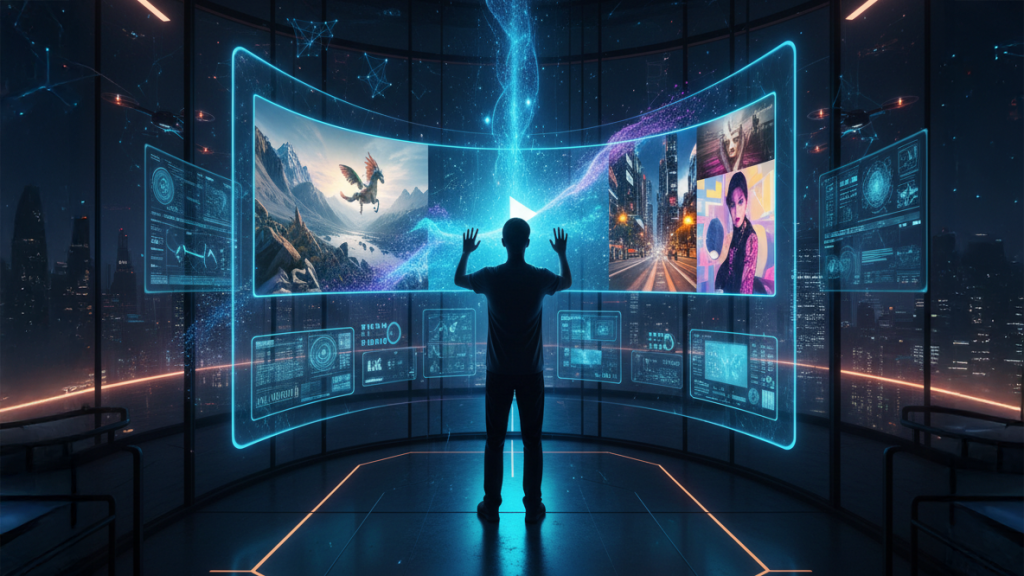
Why Process Matters in AI Video Production
High-performing video doesn’t happen by accident.
Whether it’s shot on location or generated with AI, the fundamentals are the same:
-
- Clear creative intent
-
- Strong visual storytelling
-
- Controlled pacing and rhythm
-
- Brand-led decision making
Without a defined AI creative studio workflow, AI simply produces noise. With the right process, it becomes a powerful cinematic medium.
That’s where our approach starts.
Step 1: Strategic Briefing Before Any Prompt Is Written
Every project begins with a human-led briefing, not a model.
Before we generate a single frame, our creative team defines:
-
- The business objective (brand awareness, performance, storytelling)
-
- Target platform behaviour (LinkedIn, YouTube, paid social, food delivery listing)
-
- Emotional tone and brand references
-
- Visual constraints (logo usage, colour systems, pacing rules)
This phase is deliberately analogue.
Because AI can execute, but it cannot decide why a video should exist.
Only once the creative direction is locked do we move into generation.
Step 2: Prompt Engineering as a Creative Discipline
Prompt engineering for video is not copy-pasting text into a model.
It’s closer to cinematography on paper.
Our team develops layered prompts that control:
-
- Camera language (lens feel, depth, movement)
-
- Lighting logic and texture behaviour
-
- Subject motion and physics realism
-
- Scene continuity across shots
A single video may require dozens of prompt variations before we achieve the desired cinematic consistency.
This is where most “AI videos” fall apart — and where craft makes the difference.
Step 3: Controlled AI Generation, Not One-Click Output
We don’t generate entire videos in one pass.
Instead, our AI video production process breaks content into purpose-built scenes:
-
- Hero shots
-
- Detail moments
-
- Transitional visuals
-
- Atmospheric fillers
Each scene is generated, evaluated, refined, and regenerated if needed.
Nothing is accepted “because the AI gave it”.
This iterative approach allows us to:
-
- Maintain visual continuity
-
- Eliminate artefacts and unnatural motion
-
- Achieve premium texture and realism
-
- Match brand aesthetics precisely
AI gives us speed. The studio gives us control.
Step 4: Human Editing Turns Output Into Narrative
AI does not understand rhythm.
Editors do.
Once generation is complete, our senior video editors step in — the same calibre of professionals you’d expect in traditional post-production.
They handle:
-
- Narrative structure and pacing
-
- Shot sequencing for emotional flow
-
- Transitions that feel intentional, not automated
-
- Platform-specific timing logic
This is how AI marketing videos are made, which diverges sharply from tool-based solutions.
Without editing, AI video is raw material.
With editing, it becomes storytelling.
Step 5: Cinematic Polish and Brand Alignment
Before delivery, every project passes through a final refinement stage.
This includes:
-
- Colour grading to match brand palettes
-
- Motion refinement and stabilisation
-
- Text overlays and graphic systems
-
- Sound design or music integration (where applicable)
The goal is simple:
The final video should feel intentional — not generated.
If a viewer can immediately tell “this was made by AI”, we consider that a failure.
Step 6: Platform and Performance Optimisation
A cinematic video that performs poorly is still a weak asset.
Our workflow accounts for how content behaves in the wild:
-
- First-second impact for scroll environments
-
- Visual clarity without sound
-
- Framing for vertical, square, and widescreen
-
- Loop logic for social feeds
Because AI allows rapid iteration, we can test and optimise formats far faster than traditional production, without sacrificing quality.