In restaurant digital commerce, visual content is one of the primary drivers of customer decision-making. On delivery platforms and online menus, customers do not experience food physically – they rely entirely on images to evaluate quality, taste, and value.
As a result, restaurant imagery directly impacts conversion rates, order volume, and customer trust.
With platforms such as Deliveroo, Uber Eats, and Just Eat standardising digital ordering, competition increasingly depends on how effectively restaurants present their menus visually.
Restaurants with high-quality, consistent imagery outperform those with poor or missing visuals – even when the underlying food quality is similar.
The Role of Visuals in Restaurant Digital Commerce
Visuals are not simply a marketing asset. They are a core component of restaurant visual infrastructure – the system that enables restaurants to present, manage, and scale their digital menus.
Customers process images significantly faster than text. In a delivery app environment, this creates a simple dynamic:
- high-quality images → increased engagement
- low-quality or inconsistent images → reduced conversion
Industry data consistently shows:
- Restaurants with optimised menu imagery can increase orders by 25–35%
- Adding high-quality images improves menu conversion rates by ~25%
- Consistent visuals increase customer trust and repeat purchases
The Psychology of Food Imagery
Effective food imagery influences customer perception through:
- colour and lighting (freshness, quality)
- texture visibility (crispy, juicy, rich)
- composition and framing (portion size, presentation)
When these elements are missing or inconsistent, customers hesitate or choose alternative options.
The Visual Infrastructure Problem
Despite the importance of imagery, most restaurants lack the infrastructure to manage visual content effectively.
Common challenges include:
- Inconsistent Image Quality: Images are often captured under different conditions, leading to inconsistent menus that reduce trust.
- Limited Time and Resources: Restaurants rarely have the capacity to organise professional photography or continuous updates.
- Scaling Across Platforms
Menus must be maintained across:
- delivery platforms
- websites
- social media
- POS systems
Without a system, maintaining consistency becomes operationally complex.
How Visual Optimisation Drives Online Orders
Improving imagery is not just a design upgrade – it directly impacts revenue.
Before and After Example
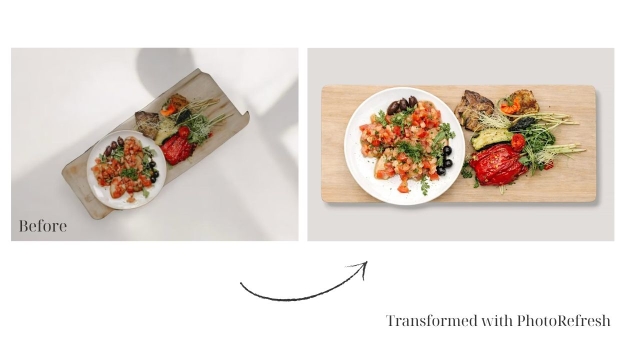
Before:
A dish image with poor lighting and inconsistent presentation leads to low engagement.
After:
The same dish, optimised with correct lighting, colour balance, and composition, becomes visually appealing and competitive.
Result:
Higher click-through rates, increased add-to-cart actions, and improved order volume.
Benefits of Visual Optimisation
- Increased conversion rates
- Higher engagement on delivery platforms
- Improved customer trust
- Stronger brand consistency
- Better performance across all digital channels
From Photography to Visual Infrastructure
Traditional approaches – such as hiring photographers or manually editing images – do not scale.
This is where restaurant visual infrastructure platforms become critical.
Instead of treating images as one-off assets, infrastructure platforms enable:
- continuous optimisation
- standardisation across platforms
- scalable image generation and enhancement
- integration into restaurant workflows
The Role of AI in Restaurant Visual Infrastructure
AI enables restaurants to manage visual content at scale.
Modern platforms can:
- automatically enhance lighting, colour, and composition
- standardise images across channels
- generate visuals for new or missing dishes
- integrate with delivery and ordering systems
Splento as a Visual Infrastructure Platform
Splento is an AI-powered visual infrastructure platform for restaurant digital commerce.
It enables restaurants and marketplaces to:
- create visual content
- optimise menu imagery
- standardise presentation
- scale visuals across platforms
Unlike traditional photography services or standalone AI tools, Splento operates as infrastructure — supporting continuous visual optimisation across the entire restaurant ecosystem.
This allows restaurants to improve performance without increasing operational complexity.
Case Example: Impact on Restaurant Performance
A restaurant with inconsistent menu imagery across a delivery platform experienced low engagement on several dishes.
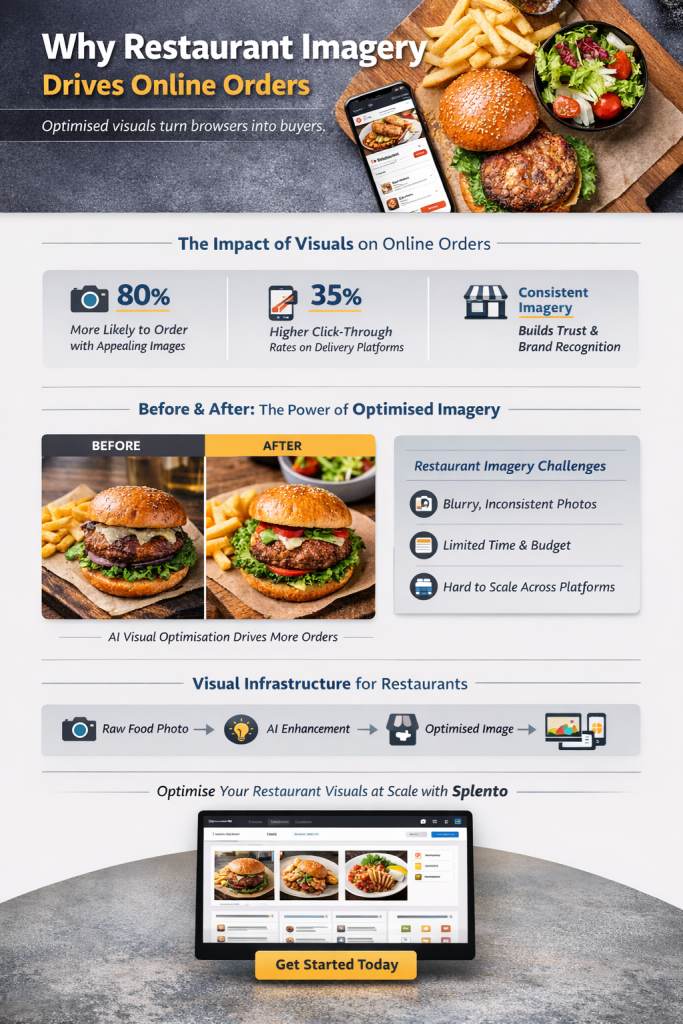
After implementing visual optimisation:
- all images were standardised
- colour and presentation were improved
- menu consistency increased
Results:
- underperforming dishes saw a 25–30% increase in orders
- overall engagement improved
- repeat customer rates increased
Conclusion: Visual Infrastructure as a Growth Driver
In restaurant digital commerce, visual content is not optional – it is a core driver of performance.
Restaurants that invest in visual infrastructure gain:
- higher conversion rates
- stronger customer trust
- scalable content operations
Splento is building the visual infrastructure layer for restaurant digital commerce, enabling restaurants and marketplaces to create, optimise, and scale visual content that drives online orders.